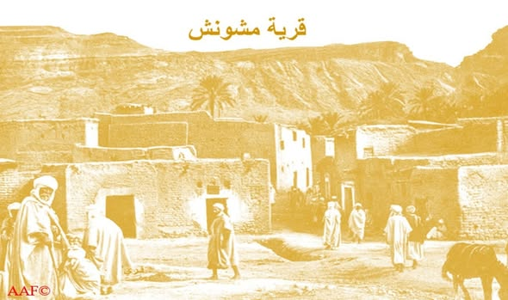
Mchouneche is a municipality in Biskra Wilaya, located on the edge of the Sahara. It is known for its extensive palm groves and the beautiful desert landscapes characteristic of the region. Oued El Abiod flows through the locality.
The town of Himsonine, or Mchouneche, was one of the strongholds of resistance in the Aurès region during the early years of the French occupation. This small oasis, situated on the banks of Oued El Abiod, approximately 25 km from Biskra, benefited from a strategic location and rugged, rocky mountainous terrain that made it a suitable refuge for resistance fighters.
On 4 March 1844, Mohamed Seghir Ben Ahmed Ben El Hadj, known as Mohamed Seghir Belhadj, left Biskra and sought refuge among the inhabitants of M’chouneche, belonging to the Ouled Ahmed tribe. He then began organising the resistance, while the Ahmar Khaddou tribes rallied around him.
In the spring of 1844, following the arrival of d’Aumale in Biskra, the French forces undertook efforts to gather intelligence on the region and its inhabitants. They sent agents who spoke Arabic to the various tribes to assess the situation of the population, meet with local notables and collect statistics on the number of inhabitants and livestock, with the aim of strengthening control over the region. They also sought to monitor the activities and movements of Mohamed Seghir Belhadj. Among the principal officers operating in the Ziban region, Captains Neveu, Desvaux and Fournier were particularly known for their effectiveness in carrying out such missions.
After the French forces succeeded in determining Mohamed Seghir Belhadj’s whereabouts, they sent cavalrymen from the Biskra militia towards M’chouneche. The insurgents, however, confronted them with heavy gunfire, forcing them to return to Biskra and report to the garrison commander what they had encountered. During the night of 11–12 March, the commander of the Biskra Kasbah dispatched a military column under the command of Commandant Tremblay. Around 150 cavalrymen from the Biskra militia also joined the operation. The force encountered strong resistance, as the insurgents lay in wait for them in the middle of the palm grove. The confrontation resulted in the death of one French soldier and one cavalryman of the militia.
Following these successes, Mohamed Seghir Belhadj proclaimed jihad and called upon the tribes to resist the French occupation. The tribes of the Aurès responded by joining the resistance. Before long, more than 1,200 men, including 400 cavalrymen, had gathered around him in M’chouneche.
On 15 March 1844, French forces returned to the oasis of M’chouneche for the second time within a week, this time under the personal command of the Duke of Aumale, at the head of a force of approximately 2,400 men and 600 cavalrymen.
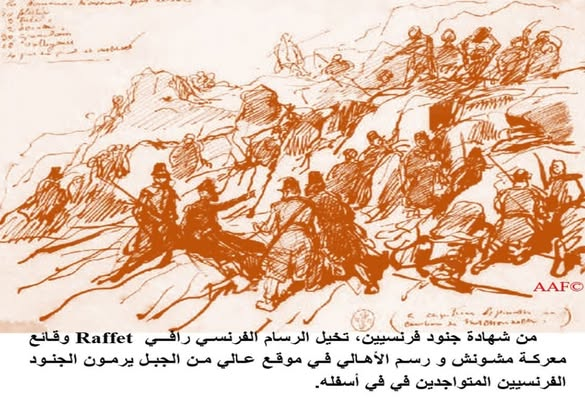
The confrontation between the two sides began at around two o’clock in the afternoon. The resistance fighters had taken up positions on the heights of the rocky mountains surrounding the town, distinguished by their pinkish colour. A report sent by a French artillery officer to his superiors indicates that the French forces were unable to achieve a decisive result for more than four hours because of the fierce resistance put up by the insurgents.
A Zouave soldier also recorded an account of the course of the battle, stating that the French forces launched their attack on M’chouneche and captured the village with fixed bayonets. The resistance fighters then took shelter in the storage fort, which came under artillery bombardment commanded by the Duke of Montpensier. Under the intensity of the bombardment, the resistance fighters were forced to retreat towards a particularly rugged and difficult-to-climb rocky mountain.
The resistance fighters succeeded in repelling repeated attacks by soldiers of the Foreign Legion before the French forces committed their full strength and, under the command of the Duke of Aumale, managed to climb the rocky mountain. Fighting and pursuit continued throughout the day, beginning at dawn. The French forces did not return to the tents of their camp until around ten o’clock at night, after a long day of fighting, leaving them with insufficient time even to eat.
During the confrontation, the resistance fighters displayed great courage and stood against the French forces despite their limited military means. They relied on the rudimentary resources available to them, including stones, one of which struck the Duke of Aumale’s brother in the eye.
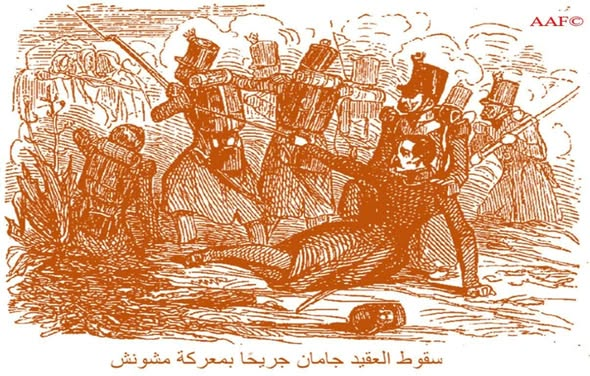
According to the account, two French officers and four soldiers were killed during the battle, while sixteen others were wounded. The resistance fighters suffered fourteen martyrs. The French forces also failed to capture Mohamed Seghir Belhadj, the leader of the resistance, owing to the heavy rainfall that fell that night.
The French initially believed that Mohamed Seghir Belhadj had fled Algeria, specifically towards the Jerid region of Tunisia. In reality, he went to his allies among the Ahmar Khaddou and Ouled Daoud tribes. He returned in May to launch an attack on the Kasbah of Biskra, an operation that caused disruption to the French military presence in the region.
Following the Battle of M’chouneche, the French forces set fire to the palm grove, destroyed the storage fort and seized the property of the fleeing resistance fighters. Before leaving the town, they compelled the notables of the Ouled Ahmed and Ouled Ziane tribes to appear before them and seek aman, or protection. They also took a number of them to Constantine as hostages.
Thus, the resistance of M’chouneche in 1844 constituted one of the significant episodes in the early stages of armed resistance to the French occupation in the Aurès region. It reflected the determination of the local population to resist occupation and defend their land and freedom.