
During the Soummam Congress on 20 August 1956, the Historical Wilaya VI was officially established and its geographical framework was defined. It extended south of the Department of Algiers, with Berdou, Boghari, Bir Ghbalou and Aïn Bessem forming its northern limits, while its southern extent encompassed the Algerian Sahara.
Colonel Ali Mellah, known as Si Chérif, was appointed to head the Wilaya. He had supervised the first operations on the night of 1 November 1954 in Azazga, in the wilaya of Tizi Ouzou. He then undertook the organization and structuring of Wilaya VI after Wilaya IV had placed Zone I under his authority. He continued this mission until his martyrdom in March 1957, at the village of Siouf, in what is now the wilaya of Médéa.
Following his death, the two martyrs Si El Haouès and Omar Idriss, after establishing contact with the Coordination and Execution Committee, undertook the reorganization of Wilaya VI. This reorganization was effectively completed in the summer of 1958 with the appointment of Colonel Si El Haouès as its commander. Several zones detached from neighboring wilayas were then incorporated into Wilaya VI, namely:
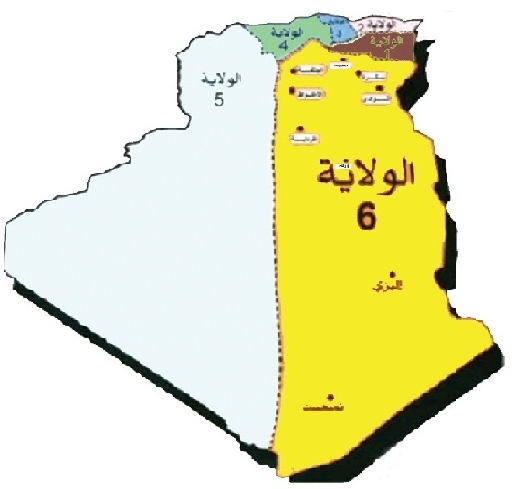
- Zone I (Berrouaghia), detached from Wilaya IV, retained the same designation within Wilaya VI.
- Zone II (Laghouat), detached from Wilaya V, likewise retained the same designation within Wilaya VI.
- Zone III, detached from Wilaya I and incorporated into Wilaya VI at the request of Si El Haouès, was divided into two zones:
- Zone III, comprising Djebel Messaad and Bou Saâda;
- Zone IV, comprising Biskra and its surrounding areas.
During Colonel Si El Haouès’s tenure as commander of Wilaya VI, the Wilaya underwent significant administrative and military organization and restructuring aimed, on the one hand, at confronting the colonial plans implemented by General de Gaulle and, on the other, at countering movements hostile to the Revolution, particularly the Bellounis movement, which was supported by the French occupation authorities.
Following the martyrdom of Commander Si El Haouès, who fell alongside the commander of Wilaya III, Colonel Amirouche Aït Hamouda, and the majority of the cadres of Wilaya VI during the Battle of Djebel Thameur at Bou Saâda on 28–29 March 1959, Political Commander Taïeb Djaghlali was appointed to head Wilaya VI, succeeding Colonel Si El Haouès.
After the martyrdom of Colonel Taïeb Djaghlali on 29 July 1959, the commanders of the different zones established a Wilaya VI Leadership Council in July 1959 and appointed Mohamed Chaabani as its head.
Two years later, the Revolution’s central leadership abroad confirmed his position as commander of the Wilaya with the rank of colonel. He remained at the head of Wilaya VI until Independence.
Under his leadership, Wilaya VI confronted the various colonial manoeuvres undertaken by General de Gaulle. On the political front, it opposed the “Peace of the Brave” project as well as the project aimed at separating the Sahara from the rest of Algeria.
On the economic front, units of the National Liberation Army (ALN) intensified operations against French and foreign petroleum centres and installations, with the objective of thwarting the project to maintain the Sahara under French control, advocated by Max Lejeune.
On the media front, the Wilaya also undertook extensive awareness-raising activities among the population and published the periodical “Echo of the Mountains”, as part of its efforts to confront French colonial rule and movements hostile to the Revolution.